Archive for January, 2007
Profit Targets: One or Two?
January 29, 2007 at 11:34 pm
I am a big proponent of planning trades as thoroughly as possible before getting in. I prefer to set my stops in one place and exit the trade all at once if I am wrong, but taking profits is another topic. At times, one profit target makes sense. Other times call for multiple profit targets.
Check out this week’s free newsletter over at TheStockBandit.com for my thoughts on planning profitable exits. And by the way, you can sign up for the free newsletter on the Free Newsletter page at TheStockBandit.com. An opt-in form is provided at the top of the page which puts you in full control of your email subscription at all times.
Trade well this week!
Jeff White
President, The Stock Bandit, Inc.
www.TheStockBandit.com
[tags]Stock Market, Trading Profits, Profit Targets, Stock Trading[/tags]
Book Review: Anatomy of the Bear
January 29, 2007 at 11:00 pm
 I love to read trading books, so when I was asked to review Russell Napier’s book, Anatomy of the Bear, I happily obliged.
In the book, Napier examines 4 major bear market bottoms on Wall St., with a portion of the book devoted to each of the major lows created in 1921, 1932, 1949 and 1982. Napier looks at the history of these bear markets, the events leading up to them, and how the investors of those times were impacted throughout the bottoming process. In his research, he examined some 70,000 articles from the Wall Street Journal from the two months before and after the final lows were made, adding some valuable perspectives from the media and traders of the day. These article tidbits give some great insights into life in the trading trenches at the time, which is incredibly helpful in painting the picture of the doom and gloom which ultimately accompanies a lasting market bottom.
Napier also takes the reader back to the situations of each of the major lows, essentially transporting you to the time and the events which led up to the bear phases. He examines wars, monetary policy, politics, economic factors, and anything else which had an impact on the buying and selling motivations of traders, making this book an incredible resource for anyone wanting to learn from lessons of the past.
Here are a few things I found noteworthy:
* Earnings Trailed Price. In the 1921 bottom, price found a low about 4 months before earnings found a bottom. Earnings bottomed some 5 months after price bottomed in the 1932 bottom. That makes for some interesting fundamental vs. technical discussion! (You know which side I’m on)
* Short Interest Stayed High After Lows. Napier discovered that short interest remained rather high even after price made a low, serving as a good reminder that even bears get greedy. In turn, as the shorts end up having to buy to exit their positions, it propels prices even higher, perpetuating the newfound momentum. Napier notes that a large short interest combined with a market that didn’t decline on bad news was an excellent signal in the 1921, 1932 and 1949 lows.
* Bear Markets Don’t Scare You Out. The results of Napier’s research flies somewhat in the face of theories which indicate that capitulation marks a lasting low, revealing instead that bear markets typically end with a final decline on no volume. Essentially, bear markets wear you out, not scare you out.
* Commodities Count. The end of commodity price declines also marked all 4 major equity lows, with copper playing a prominent role as it preceded or coincided with every equity rebound.
The book also ends with a great number of strategic and tactical conclusions drawn from the study of these 4 great bear markets – plenty of reason alone to check out this book.
Thanks to Russell Napier for the chance to review this fine study of the past, I enjoyed the read and learned a great deal from the bear markets of the past.
Jeff White
President, The Stock Bandit, Inc.
www.TheStockBandit.com
[tags]Stock Market Books, Bear Market, Stock Market Lows, Russell Napier[/tags]
Day Trading: The CNBC Debate
January 27, 2007 at 1:57 pm
As I watched CNBC’s clip on the return of day trading Friday, I was entertained by the banter. On one side was Trey Robinson, an acquaintance of mine from CyberTrader who just happens to be the Director of Business Development (who would possibly know more about the scope of traders in the market today?). On the other side of the argument was Michael Farr, a long-term portfolio manager who clearly knows very little about day traders being that he only deals with buy-and-hope hold investors.
Day Trading Differently
Trey discussed the higher net-worth clients that are accounting for the increased level of day trading in recent months (there has been a lot of buzz lately regarding this), and it’s not surprising to hear that much of today’s trading crowd is notably different than the bubble crowd of several years ago.
 Trey Robinson of CyberTrader discusses today’s day trader on CNBC. (Click image to launch video)
By taking a portion of their portfolio to day trade, the new crowd is able to diversify their timeframe rather than just attempt to match the market’s returns over time. They’re also using sophisticated tools to help execute their trading strategy while reducing risk. Truly a sophisticated new breed of day traders, no doubt.
Long-Term Investing Contradictions
As Michael started to speak about day traders, he wasted little time before jumping right to unfounded claims such as “these people are speculating and not investing,” and that “when the music stops, it’s over.” He also added that “when the general trend turns down, these people don’t make money.”
How ironic! He failed to mention that a long-term investor such as himself can indeed suffer considerable losses during a market correction, especially considering how few are hedged or short selling the way most day traders do. It’s also interesting to note that his long-term investors can be at greater risk than a day trader during a downturn, especially considering that they are mostly invested at all times and a day trader can take a position in cash (thereby preserving capital, not losing it).
Michael also failed to mention that even long-term investing also involves a level of speculation. After all, what guarantee does any investor have that his choice of investment (whether day trading or long-term investing) will produce a profit as expected? There are no guarantees in the stock market, regardless of timeframe.
Day Trading Reduces Exposure to Risk
On Friday at TheStockBandit.com, some members and I were discussing on my trading blog the sizeable downside gap in HAR after the company had reported earnings. Interestingly, a day trader would have had no exposure to the risk of an earnings gap which occurs overnight, but the long-term “investor” would have felt the full sting.
Same thing for the incredible downside market gap which followed 9/11: no harm to the pure day traders, but long-term investors needed considerable time to recover.
It’s pretty clear that even long-term investing involves significant risk (geopolitical event risk, earnings gaps, analyst downgrades, etc.), but one can easily argue that day trading reduces the exposure to risk due to the limited holding periods. Who can disagree with that?
Jeff White
President, The Stock Bandit, Inc.
www.TheStockBandit.com
[tags]Stock Trading, Day Trading, CNBC, Stock Market[/tags]
When To Use Line Charts
January 25, 2007 at 9:57 am
Most of us use bar charts or candlestick charts, but you don’t see a lot of line charts these days. The reason why is that a line chart is generally drawn using only the closing level of a stock, so it paints the end result and leaves out a lot of the “noise” along the way.
Line charts do have their place in trading, and I’ll give you a good example of a time when I use them. I look through a ton of charts every night, and you might too. What you find when you do that is that you’ll run across stocks which just give you the feeling that they’re about to move a certain way. Typically, I’ll draw trend lines and look for well-defined chart patterns to provide entry and exit levels for new trades. However, some charts just aren’t clean enough to do that effectively, so I’ll switch over from a bar chart to a line chart.
Let’s look at an example of this.
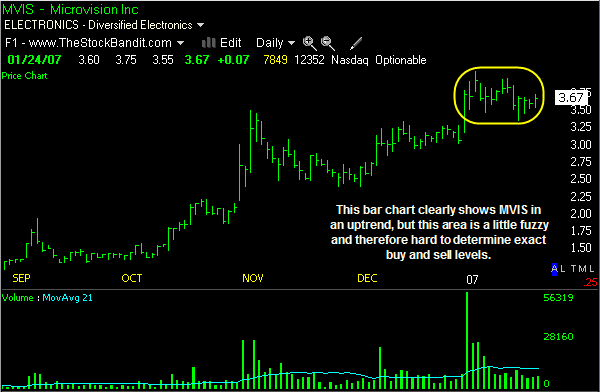
MVIS is in an uptrend, and one look at this bar chart does show higher lows along the way. The problem is, the past 15 bars or so are in sort of a messy area, making it hard to determine a precise entry and exit level without giving the stock too much room. (Click the chart below for full size)
So MVIS looks good for some upside, but we can’t find an exact entry. Switch over to a line chart format and it’s amazing how much cleaner the stock looks now. We have a nice base here with this descending channel pattern, giving us a well-defined entry level and exit level (above and below the channel, respectively). (Click the chart below for full size)
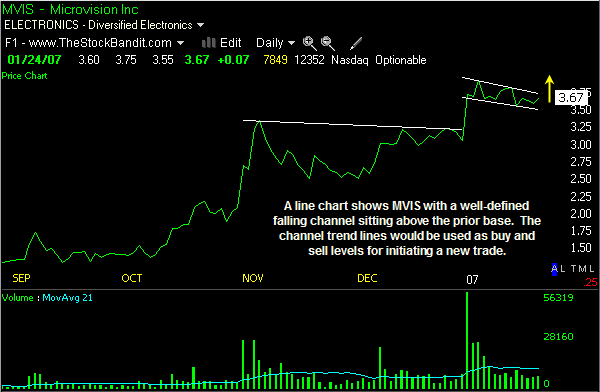
The next time you have that gut feel that a stock might be gearing up for a move but you can’t pick a good spot to structure your trade, try a line chart. You’ll find the levels will often be much cleaner, and you’ll trade more effectively because of it.
Jeff White
President, The Stock Bandit, Inc.
www.TheStockBandit.com
Slow Movers Can Be Steady
January 22, 2007 at 12:22 pm
Every stock moves differently than the next, and a big part of trading well includes matching your personality with the personalities of the stocks you trade.
After all, if you’re an impatient type-A person, you’re probably not trading MSFT because the thing moves so slowly. On the other hand, you may like the slow and steady type of stock because it fits your trading timeframe.
If the latter describes you and you’re a patient trader, check out IACI. It’s been in a steady uptrend for many months now, and it’s just now trying to break out of a bullish ascending triangle pattern. That should spell upside continuation for the stock if the pattern is confirmed. I see an earnings date set for 2/8/07, and I would be out of this trade by then as that could have a big impact on this stock one way or another. Here’s a look at the chart:
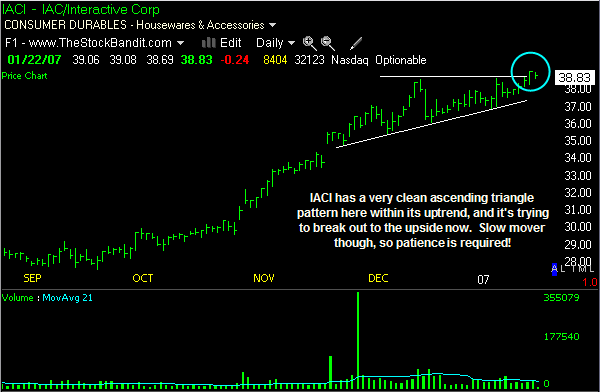 (Click for full size.) Chart Courtesy of TeleChart.
Jeff White
President, The Stock Bandit, Inc.
www.TheStockBandit.com
Potential Market Shifts
January 21, 2007 at 6:33 pm
As traders, we always have to stay aware of our surroundings. Ideally, we’re seeking to maintain an edge on our competition, and that means trying to determine with some degree of accuracy what may happen next.
I’m no fortune-teller and I never make market predictions, so instead I constantly ask a handful of questions regarding the market’s behavior. With last week’s failed breakout fresh on my mind, I’m watching for potential market shifts just in case. This may only be some temporary weakness, or it may be a warning that something bigger is on the horizon – it’s just too early to know for sure yet. What we CAN do is to gauge the character of the market, and that’s what I’ll be focused on this week.
Check out this week’s Free Newsletter at TheStockBandit.com where I discuss 4 factors I use to determine market strength when watching for potential market shifts. And when you do, make up your own mind whether or not the bull in the picture looks safe!
By the way, you can sign up for the free newsletter on the Free Newsletter page at TheStockBandit.com. An opt-in form is provided at the top of the page which puts you in full control of your email subscription at all times.
Trade well out there this week!
Jeff White
President, The Stock Bandit, Inc.
www.TheStockBandit.com
Trend Lines Often Need Adjustments
January 17, 2007 at 1:41 pm
 Technical analysis offers a number or tools and indicators to apply to charts in order to better determine buy and sell areas. Some traders have hard-and-fast rules regarding their analysis tools (and I’m a big proponent of having trading rules in place), but there are parts of technical analysis which do require some ongoing flexibility.
Trend lines are the tool I use the most in my trading and charting, and they definitely require keeping an open mind. Drawing trend lines and trading effectively with them is certainly more of an art than a science, because they can morph over time. While a trend line can be defined as a straight line connecting at least two relative highs or relative lows, what’s often left off of the description is that they frequently need to be refined.
The first time I draw a trend line, I usually consider it to be a rough draft. That means I’m willing to adjust it slightly as the chart pattern begins to mature and time goes by. The more times that price bars touch a trend line, the more valid it becomes. However, not every break of a trend line leads to another meaningful move in price. Therefore, if price pierces the trend line slightly but there’s no change of character in the underlying stock (or index or futures), that’s my signal that the break is of less significance and I’ll likely need to adjust my trend lines.
My aim is not to be perfect the first time I set a trend line. What I want is to have something valid I can trade from, as that will not only increase my confidence in the trade but also my profitability over time.
Technical analysis tools exist to help us, not bind us as traders! Trend lines are usually a work in progress and therefore rarely set in stone. Keep this in mind if you use them in your trading, and try to be sure that something meaningful is occurring when you see a trend line being broken. If the volume is up or the momentum is building, you can take the trade with much greater confidence.
Jeff White
President, The Stock Bandit, Inc.
www.TheStockBandit.com