Archive for January, 2006
Don’t Forget Your Game Face
January 30, 2006 at 2:00 pm
Bring your very best or don’t show up at all. That’s the attitude to have when it comes to many competitive activities, and trading is definitely one of them.
Last week, Kobe Bryant put up 81 points one night. Now, I’m actually a Spurs fan (and we don’t like the Lakers!), but I couldn’t help but be impressed by Kobe’s performance. Without question, Kobe had his entire focus on doing his job to the best of his ability. Every time he got the ball, he was on a mission. His focus kept him from being distracted by anything else. Marital problems? Nah. Tabloid rumors? Nope. Disputes with the coach? No way. He had his game face on and nothing stopped him.
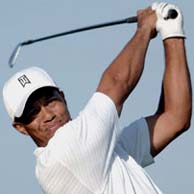
Tiger Woods shows up ready to play every time out, and he stays home otherwise. Think about what an approach like that could do for your trading results!
Take the same approach with trading. The first thing I try to consider each day is how do I feel. Physically, it’s important to be healthy and alert, but a quick mental check will help you to determine how you should trade today, if at all.
If you’ve got off-the-court issues bothering you, don’t get in the game. If doing those taxes late last night left you with your head in a fog today, you shouldn’t be trading. If one of your relationships is rocky and you can’t commit your concentration to trading, then today probably won’t be your day to trade. If you have family in town visiting and you feel obligated to entertain, then your trading is going to suffer.
Priorities like health, family and relationships, and a to-do list longer than you prefer can often mean sub-par trading results. Consider sitting on your hands during those times when your situation leaves you with less than 100% focus. A little patience with priorities never hurt anyone. And when you return to trading, make sure you bring your game face!
Jeff White
President, The Stock Bandit, Inc.
www.TheStockBandit.com
What A Breakout Looks Like
January 24, 2006 at 5:14 pm
Last night in my stock newsletter, I highlighted ICE for a swing trading candidate on the long side if it could make new highs at $48.50. Here’s the chart I showed in last night’s newsletter:
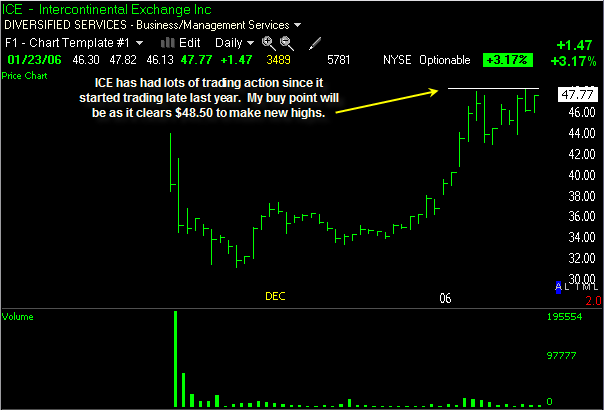
I particularly liked the recent volatility following this stock’s uptrend, along with the fact that this stock was testing the recent highs. Throw into the mix that ICE has been making higher lows in the past couple of weeks, and the ingredients of a good setup were complete. A break above the horizontal line was the entry point I showed to my subscribers, and today ICE raced higher all day long, adding more than 10% to show us a gain of more than $4.00 per share!
Here’s a look at the ICE chart after today, with the breakout very easily seen:
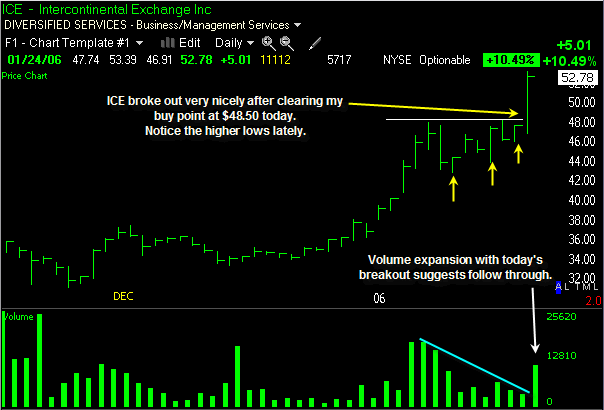
Don’t be afraid of trading the new issues like ICE. Just because a stock has less trading history than many others out there doesn’t mean that you can’t catch a great move out of quality chart patterns!
To catch moves like this with me instead of hearing about them from me, sign up for your 2-week free trial to my stock pick service!
Jeff White
President, The Stock Bandit, Inc.
www.TheStockBandit.com
Another Definition of Trading
January 23, 2006 at 6:20 pm
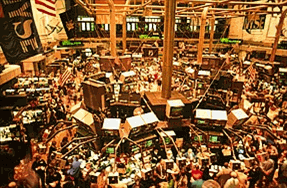 Most people think that trading is the buying and selling of stocks. I suppose it is, but I often say that trading is the continual process of making and losing money. This is true! A trader’s success all boils down to making more when he’s right and losing less when he’s wrong. What matters is the difference between how much you make and how little you give back!
I’m right more often than I’m wrong, but that wouldn’t necessarily have to be the case for me to make money. By managing trades properly, a trader could be 50/50 or even worse and still come out profitably. It’s about taking small losses and sticking with the winning trades to overcome the small losses.
Knowing that I’ll be wrong certainly helps me to accept a losing trade. Every day when I settle into my routine, I’m aware that I will probably have at least one losing trade – but that doesn’t stop me from trading (or making money). That awareness doesn’t hurt my confidence, but instead it keeps my ego suppressed. I know that I’ll be wrong, so when I am, it’s far easier to hit the sell button and wipe that small mistake off my screen. Then I can focus on my winning stocks without the eyesores and annoyances of stocks moving opposite of what I had anticipated.
Don’t let your ego interfere with your trading! Going to battle with a losing trade by adding to it or simply letting the truck roll over you without getting out of the way are all due to ego. Accept that there will be some losses, commit to keeping them small, and stay focused on getting the most out of your winning trades.
Follow my trades and see how I manage both winners and losers with a 2-week trial to my swing trading service. You’ll like the net result!
Jeff White
President, The Stock Bandit, Inc.
www.TheStockBandit.com
Simplify Your Trading Layout
January 20, 2006 at 10:00 am
 Trading platforms have come a long way in just a short time. Now you can set up your trading layout just the way you want it, reflecting all kinds of information back at you to enhance your decision-making process. It’s easier than ever to monitor positions, set a quick stop-loss order, and watch multiple timeframes with several charts. But that doesn’t necessarily mean that more is better!
Information overload is a widely-used term but it certainly applies to trading. I’ve known more than a few traders who suffer from paralysis by analysis. It’s easy to get so into the information that you fail to remember what it’s all there for – trading to make money! If you’re overcomplicating things and getting too wrapped up in making sure all the stars are aligned before you can pull the trigger on a good trade, then maybe it’s time to streamline your process.
Take a good look at the information your trading layout displays for you. Do you need it all? Are those indicators doing anything for you other than just adding color to the charts? Is there conflicting information which is regularly keeping you from capturing good moves in this market?
Start with the bare essentials for trading: a level 2 window, an open positions window, a chart of the futures, a chart for your stocks, and a ticker. Add only what you need to this list, and soon you’ll be able to monitor positions and market momentum without getting lost in the shuffle. Simplify your layout and spend your time and energy focusing on the tape this year rather than suffering from information overload!
Jeff White
President, The Stock Bandit, Inc.
www.TheStockBandit.com
My Biggest Trading Fear
January 18, 2006 at 4:24 pm
My trading strategy is not one that will have me so exposed to any particular trade that if something bad happened I would be wiped out. Because of this, my fear isn’t that I will someday have to take a giant loss on a bad trade. Yes, I will be wrong and take my medicine, but that’s not a big concern to me.
The losing streak is the big bad ugly monster I don’t want to fall victim to. I’ve known a number of traders who allowed losing streaks to continue, and it’s scary. A losing streak leaves a trader not knowing which way is up. During a losing streak, you don’t know what to trade, when to trade, or which way to trade. You don’t know which indicators are meaningful and which are useless. Choppiness looks like a tradable pattern and what ultimately gets chopped up is your account. You’ll change your approach daily, never giving any strategy a fair evaluation. You may even start trading opposite of what you think, just to put an end to it. In short, you become clueless, and are never the same.

This is of course my 2nd biggest fear
No thank you!
Every trader needs capital to trade. Cash in an account is one type of capital, but psychological capital is certainly another equal requirement. A trader must have the courage to act on his convictions and put that cash into play. Losing streaks cost money, no doubt, but more importantly they cost a trader confidence. Money can be borrowed, but without confidence, a trader simply becomes a cash holder with no ability to seize opportunity.
Protect your confidence at all times, with as much vigilance as you protect your trading account. When you start losing money, take every measure to stop it. Cut down your trading size, trade less often, and wait for more clarity. Put on the brakes to stop a losing streak, and you’ll avoid the nasty long-term damage it can cause to your trading career.
Jeff White
President, The Stock Bandit, Inc.
www.TheStockBandit.com
Intuition or Into Wishing?
January 17, 2006 at 8:47 am
 The Market Wizards books by Jack Schwager are must-read books for traders of all kinds. These books are loaded with interviews with top traders, and it’s interesting to learn how the featured traders made it to the top of their profession.
One of the featured traders is Ed Seykota, who reportedly was up 250,000 percent between 1972 and 1988 – very much a wizard! Ed’s interview is filled with great insights as to what drives traders, and his play on words in many cases proves to be accurate. One quote that Ed makes is:
“Be sensitive to the subtle differences between ‘intuition’ and ‘into wishing.’”
What great advice! As traders, we all fight the internal battle between what our “gut” is telling us and what we want to happen based on the positions we are holding at any given time. An experienced trader should allow intuition to play a part in the decision-making process when trading, but it certainly is a fine line between what our gut tells us and what our opinions leave us hoping for!
Keep Ed’s quote on your mind and always be aware of what it is that’s driving your next trading decision. Remember, HOPE is not a trading strategy!
Jeff White
President, The Stock Bandit, Inc.
www.TheStockBandit.com
Links for a Day Off
January 16, 2006 at 2:48 pm
With the market closed, it’s good to be able to do some catching up. Here’s a slew of links I’ve recently run across which you might find interesting while passing time on a quiet Monday.
On again, off again….Make up your mind already!
Mel Gibson and Danny Glover would be proud
Daring to be Great: Trading Lessons from the “Splendid Splinter”
Getting Comfortable with Uncertainty
Two Year Old called for Jury Duty
But will they sound as good as the classics?
Also, SeekingAlpha is offering transcripts for Conference Calls this earnings season.
Jeff White
President, The Stock Bandit, Inc.
www.TheStockBandit.com