All Entries in the "Trade Management" Category
Ron Artest, Scrabble & Trading – WTBR Episode 4
April 24, 2012 at 8:40 am
 Today, I bring you Episode 4 of When The Bell Rings.
In this episode, we’re talking about something that’s paramount to your success as a trader. It’s a mindset, but it’s something that requires intentional planning and not a fly by the seat of your pants mentality.
A weekend sporting event was too pressing to delay this message any further, so here it is.
I hope you get a lot out of this installment. Keep coming back for more in the days ahead, and of course if you find these helpful, then let me know!
Run time is 4:26.
(Direct video link is here for those interested in embedding it elsewhere to share).
Trade Like a Bandit!
Jeff White
Producer of The Bandit Broadcast
Get our free newsletter to keep up!
Follow @TheStockBandit
Week 16 Trades Review (Video)
April 20, 2012 at 10:05 pm
 Week 16 is in the books, and truth be told, I would have been better served to have sat on my hands!
I wanted to offer a video recap of the trades I took. As you’ll see, I was stopped out several times on head-fake types of entries with stocks showing extremely limited follow through in either direction.
On weeks like this, it’s nice to be limiting risk. Each of us will encounter stretches where failed trades happen more often, and this was that week for me. I found a few winners, but the key for me was limiting my losses in order to maintain my objectivity and minimize the damage. This is where setting ego aside can truly save you in your trading, as backing away with smaller size on messy weeks will leave you digging shallower holes by digging with a smaller shovel!
This show-and-tell look at the trades I took this week should give you a feel for not only how I managed my trades, but also the kinds of setups which have been working well of late. And for those curious about our trading style in the member area, this should give you a good indication of what a typical week looks like. Check out the trial if you’re interested in adding our ideas to your own.
(Direct video link is here for those interested in embedding it elsewhere to share).
Be sure to view in HD (720P) and full-screen mode for best quality in the video.
Trade Like a Bandit!
Jeff White
Producer of The Bandit Broadcast
Get our free newsletter to keep up!
Follow @TheStockBandit
Gap Strategy on Swing Trades
April 19, 2012 at 9:01 am
A Bandit subscriber recently asked me about dealing with gaps on swing trades. This was a great question, so I wanted to be sure to share this exchange with you in hopes of you adding your thoughts on this as well.
Background on the Situation:
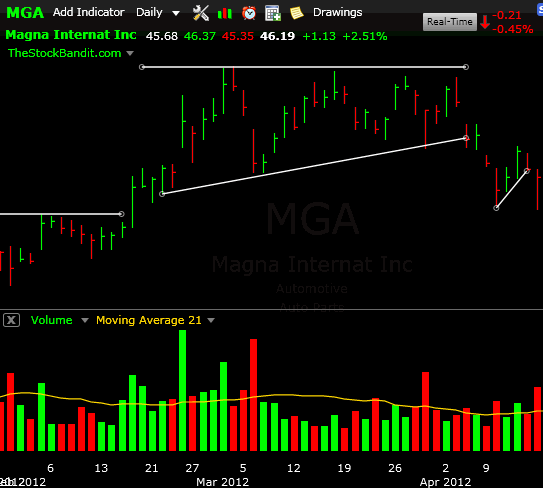 This question came in reference to a swing trade I had listed Sunday night inside our member area. MGA had fallen below an ascending triangle pattern the previous week and bounced back up to test the breakdown area only to stall out. This appeared to be a potential short-term lower high (and failing bounce), so I listed it as a short sale heading into Monday’s session if it broke the rising trend line at $45.20 (see chart).
This was to be a swing trade, which is an overnight position – at least until target or stop levels had been hit. My swing trading strategy allows for some gapping beyond my intended entries, but then I scale back my size the further a stock gaps. This helps offset the added risk with a wider discrepancy between my actual entry and my initial stop loss.
In the case of MGA, it gapped 2.8%, warranting only a partial position of 1/4 size. The gap was filled quickly, and I ultimately stopped out Tuesday as the bounce continued, taking a loss on this very small position. Nonetheless, that’s the setting here under which this trader asks the following questions.
Question:
Jeff, most of the time when I set up my bracket orders for swing trades my initial trigger to open a position is a stop limit order. I use the limit order portion when I am working during the day and cannot actively adjust for gaps, as this way I don’t by default enter the trade in less than ideal conditions. In the case of MGA which had the immediate pullback, I was in moments after the opening. So my question is in general trades like MGA that return back to the original trigger levels should I let the trade continue or would I be better off passing on the trade?
Thanks
Answer:
Great question. I take it from your question you have mobile access or some way to get in and make an adjustment to the trade once you’re in. Some brokers offer several levels of sophistication with regard to managing orders like this, but if you are not inclined to complicate things then I’d say on trades like this just pass on it. The best trades for me tend to not come back to the trigger or go against me right off the bat. That is more characteristic of the losing trades I make.
I’d say to keep things simple, if the stock gaps beyond a certain amount you specify, then just skip it, or next-best scenario would be to just close out the position as soon as you notice you were filled. Either you got a price you didn’t like or you have more shares at that price than you want, but the point is you recognize it’s not the trade you had intended to take. Closing these out may mean a small gain or loss, but I suspect those will wash out over time and overall you’re sticking with an overall gap strategy which is suitable for your unique needs.
How do you manage gaps on entries when you’re away from your screens?
What would you tell this trader?
Trade Like a Bandit!
Jeff White
Producer of The Bandit Broadcast
Get our free newsletter to keep up!
Follow @TheStockBandit
Be Present – When The Bell Rings 3
April 18, 2012 at 8:48 am
 Today, I bring you Episode 3 of When The Bell Rings.
In this episode, we’re talking about a common mistake among traders which seems so obvious – yet so few make it a point to avoid.
I hope you get a lot out of this installment. Keep coming back for more in the days ahead, and of course if you find these helpful, then let me know!
Run time is 4:07.
(Direct video link is here for those interested in embedding it elsewhere to share).
By the way, here are links to Episode 1 and Episode 2 in case you missed them.
Trade Like a Bandit!
Jeff White
Producer of The Bandit Broadcast
Get our free newsletter to keep up!
Follow @TheStockBandit
Week 15 Trades Review (Video)
April 14, 2012 at 10:06 pm
 Week 15 is in the books, and while it was far from impressive for the overall market, our trades fared well.
I wanted to offer a video recap of the trades I took. The previous week wasn’t great for me, but week 15 was worth trading and I was able to limit losses on failed trades while booking some solid gains in those which worked.
This show-and-tell look at the trades I took this week should give you a feel for not only how I managed my trades, but also the kinds of setups which have been working well of late. And for those curious about our trading style in the member area, this should give you a good indication of what a typical week looks like. Check out the trial if you’re interested in adding our ideas to your own.
(Direct video link is here for those interested in embedding it elsewhere to share).
Be sure to view in HD (720P) and full-screen mode for best quality in the video.
Trade Like a Bandit!
Jeff White
Producer of The Bandit Broadcast
Get our free newsletter to keep up!
Follow @TheStockBandit
Strategic Adjustments that Pay Off Big
April 12, 2012 at 7:40 am
 Like sports and business, trading requires the ability and the willingness to adapt. This involves continually learning and growing so that you’re never stagnant with a single approach.
Recently I sat down with Tim Bourquin for a MoneyShow Interview, and we discussed this topic of how Strategic Adjustments can Pay Off Big. The clip is 3 minutes and can be viewed here.
In the segment, we discuss trading biases, contingency plans, backing down when you’re uncertain, and the importance of focusing on a single market while still allowing yourself some ways to diversify within it.
(Other 3-minute videos from this same interview discuss The Trade Plan that Works For Me, as well as Win More by Risking Less, which you may also enjoy.)
Trade Like a Bandit!
Jeff White
Producer of The Bandit Broadcast
Get our free newsletter to keep up!
Follow @TheStockBandit
Yard Crew Traders – When The Bell Rings 2
April 10, 2012 at 7:35 am
 Today, I bring you Episode 2 of When The Bell Rings.
Hopefully you caught Episode 1 last week which lays the groundwork for where this series gets its name. If not, check it out first!
In this episode, we’re talking about something which many traders fall into the habit of doing, but fail to recognize it until it’s too late. Once that happens, they tend to just accept it even though it leaves them at a huge disadvantage.
I hope you get a lot out of this second installment. Keep coming back for more in the days ahead, and of course if you find these helpful, then let me know!
(Direct video link is here for those interested in embedding it elsewhere to share).
Trade Like a Bandit!
Jeff White
Producer of The Bandit Broadcast
Get our free newsletter to keep up!
Follow @TheStockBandit